
A Substack about a Substack
Thinking about the Senate's new publication
It was a slow week on Beacon Hill, with school vacation happening, so I want to take the time to talk about something that may be of interest to very few people across the state, but since you’re reading a Substack about Massachusetts politics, I hope you’re one of them.
The Senate recently created its own Substack newsletter, run by the Senate President’s communications team. Its latest article is here:

I am very much in favor of anything that bring more awareness of what’s happening on Beacon Hill and explain to the public about the legislative process.
But there was something a little odd about this article that didn’t sit right. I couldn’t figure out what it was. It was a well written article about an important topic (capital investment in public universities) and even started with a good anecdote. It ended on a hopeful note.
With the BRIGHT Act, Massachusetts is making its most significant higher education capital investment in nearly two decades. Together, we are choosing not to retreat in the face of federal attacks on higher education, but to build forward, better.
I didn’t realize the problem until I read in Politico Playbook that the Senate, as a legislative body, hadn’t yet voted on the bill, but the Senate, as a mini-media outlet, was promoting it.
Can a chamber act as an editor?
If this had been published in Sen. Comerford’s personal Substack, there would be no problem. If it had been on the Substack of the Senate President, again, no concerns.
But the fact is that this is published as coming from masenate.substack.com. That implies that this is the outlet for the entire 40-member institution.
Do all 40 members agree with this article coming out with the brand name of the institution? Maybe so. But what if they don’t? It raises a few obvious questions:
Would this outlet publish an article promoting a bill that 39 of its members support but 1 opposes?
All Democrats and no Republicans?
What about Mayor Wu’s tax shift proposal that was defeated 33-5? Would it have published an article from Sen. Brownsberger against it and Sen. Rush in favor?
And, more importantly, what would be the thought process for any of those calls?
Does this matter at all?
Probably not. We’re talking about a Substack newsletter. It’s not itself shaping policy.
However, on a deeper level, maybe it does. In my time working around state government, one of the common refrains has been that we in Massachusetts don’t often have real debates. I remember being at an event where a local reporter complained that he would often publish pieces with only one side of an argument quoted, to be called later and told that most people in the building disagreed, but hadn’t been willing to go on the record.
The Senate and the House are supposed to be the arenas within which debates and discussions take place. They, as institutions, are not supposed to have the viewpoint themselves, so maybe they shouldn’t have the editorial power to elevate a particular viewpoint.
I’m still looking forward to reading every issue
On net, I think that this is still a good initiative. As they say in their introductory issue, they want to provide:
Regular updates on major initiatives and votes.
Behind-the-scenes context on complex policy areas and how we get to ‘yes.’
Voices from across the Senate, sharing perspectives on issues that impact your community.
That’s generally a good thing. The more transparency and clarity, the better. But my concern lies is what context is present and which voices are elevated.
I have no expectations that the newsletter will feature every Senator on every issue. Indeed, there’s already a place for Senators to speak their mind and that’s the Senate. But having some clear standards about what kinds of legislation I can expect to see discussed and how those decisions are made will go a long way into helping build understanding.
I believe that this is the first legislative body to have a Substack, which does show Massachusetts taking the lead in a new type of civic outreach, but it also means that new practices are required to fit those two very different things together.
This Week in Bluesky
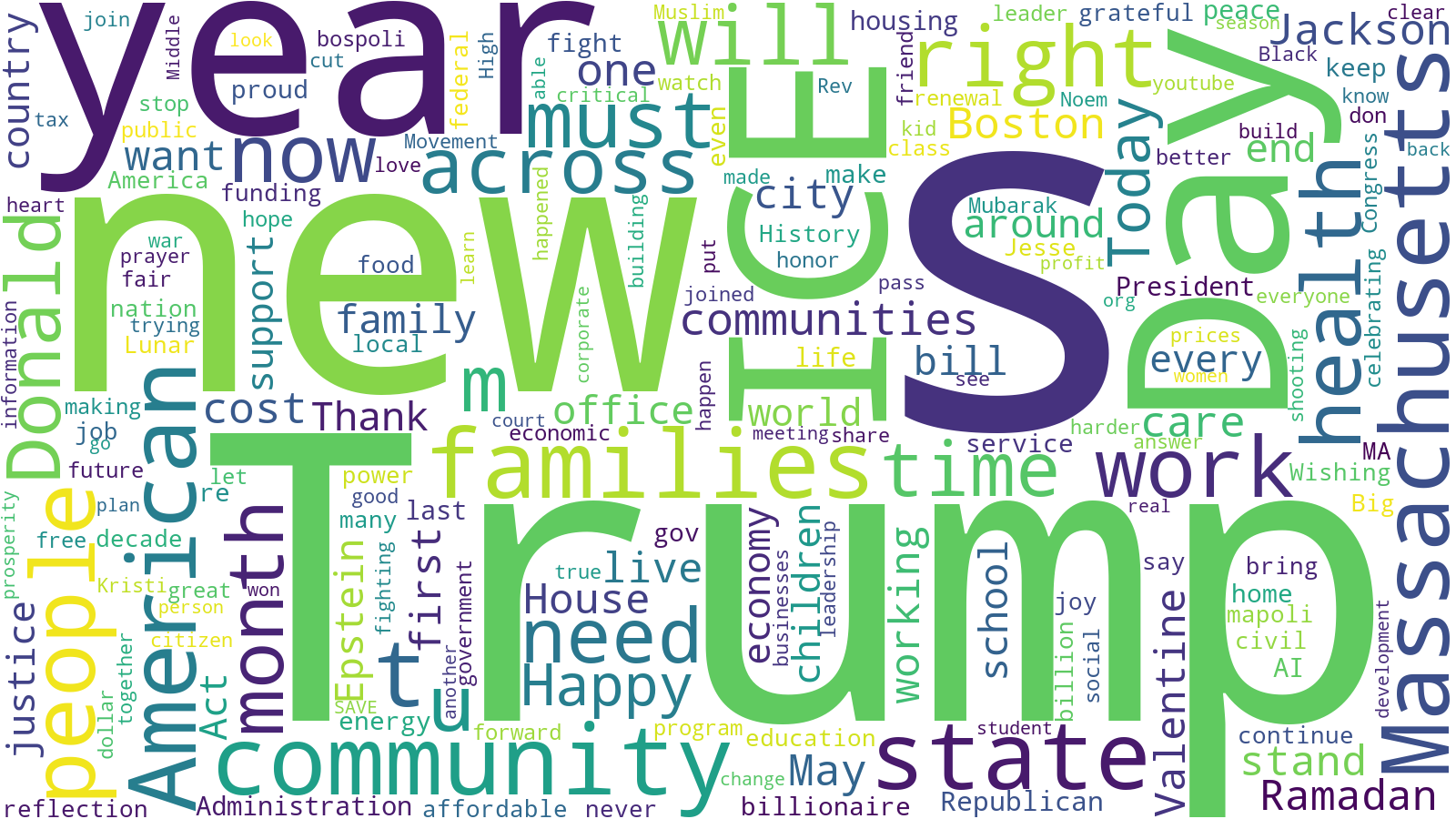
The lunar new year and Ramadan appeared in the #mapoli wordcloud, along with ICE and President’s Day.
Top post of the week
Top non-federal post of the week
This was also the best performing post, with an engagement per follower score of 0.27